This is the most common call we get between June and September. Someone spent a reasonable amount of money on waterproofing eighteen months ago, the monsoon arrived, and there’s a damp patch spreading across the bedroom ceiling again.
The client’s assumption is usually that they were sold bad material. That’s almost never what happened.
Waterproofing failures in Kerala are overwhelmingly application failures, not material failures. Manufacturers test these products extensively. The membrane that failed on your terrace is probably performing fine on ten thousand other buildings. Something specific went wrong on yours — and identifying which of these seven it was determines whether you need a ₹15,000 repair or a ₹1,20,000 redo.
1. The surface wasn’t prepared
This causes more failures than everything else combined.
Waterproofing bonds to the substrate. If the substrate has laitance, loose cement particles, oil, algae, old flaking paint, or is simply dusty, the membrane bonds to that layer instead of to the concrete. It looks perfect on day one. Then thermal movement peels it off from underneath, and by the second monsoon water is travelling freely in the gap between membrane and slab.
This is also why leaks appear far from their entry point. Water enters at a debonded patch near the parapet, runs along under the membrane, and drops through a slab crack in the middle of the room.
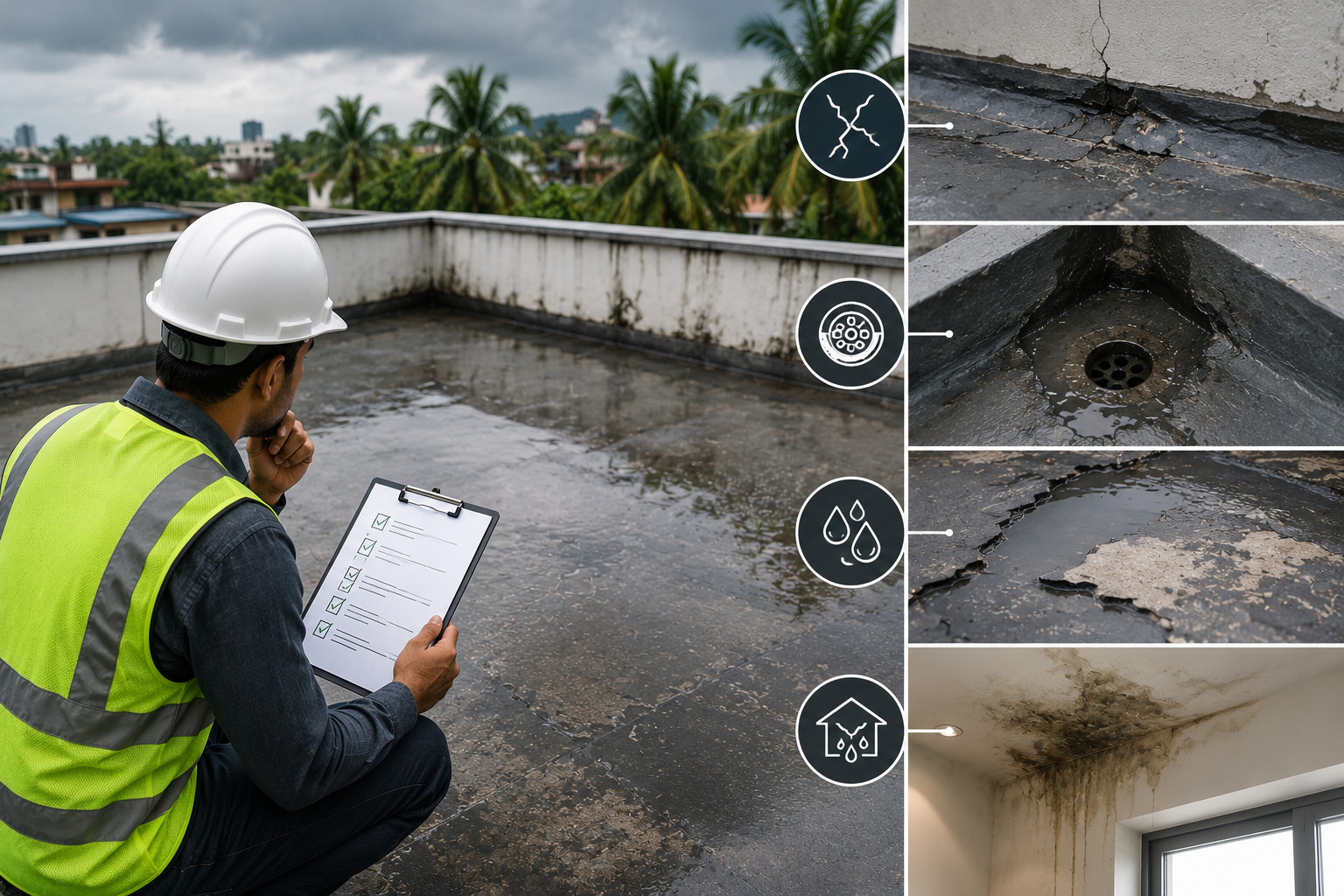
How to spot it: The membrane looks intact but sounds hollow when tapped. Peeling at edges. Blisters.
Proper preparation means grinding or wire-brushing to sound concrete, removing all loose material, washing, and letting it dry completely. It’s dull, unglamorous work that takes a full day on a 1,000 sq ft terrace, and it’s the first thing cut when someone quotes a low rate.
2. Water is still ponding
If your terrace holds water for more than a day after rain, waterproofing was never going to solve it.
Standing water applies constant hydrostatic pressure, keeps the membrane permanently saturated, and — in Kerala’s climate — grows algae that lifts coatings over time. No membrane is designed for permanent immersion on a roof.
A terrace needs a minimum fall of about 1 in 100 toward outlets. Many Kerala houses, particularly older ones and those where the terrace was screeded by a mason without a level, have flat or reverse-sloped areas.
How to spot it: Go up two hours after heavy rain. Water pooling anywhere is your answer.
Fixing this means slope correction screed before waterproofing. It costs more. It’s also the difference between a ten-year job and a two-year one.
3. Junctions and penetrations weren’t detailed
Roughly nine out of ten leaks enter at a junction, not in the open field of the terrace.
The vulnerable points:
- Parapet-to-slab corner (needs a fillet/cove, not a sharp 90° turn — membranes crack at sharp angles)
- Plumbing and drain pipe penetrations
- Water tank supports and AC platform bases
- Staircase room walls meeting the terrace
- Railing post bases drilled into the slab
- Expansion and construction joints
The open area is easy work. The junctions are skilled, slow, fiddly detailing. A crew paid by the square foot has every incentive to rush them.
How to spot it: Leak location inside roughly corresponds to a parapet, pipe or tank position above.
4. The membrane is too thin
Every waterproofing product specifies a dry film thickness or a coverage rate. If a system requires 1.5 kg/sq m across two coats and the applicator spread it at 0.9 kg to make the material stretch further, you have a system operating at 60% of its designed thickness.
It will still look completely finished. It will fail in half the time.
How to spot it: Hard to detect visually — which is exactly why it happens. The defence is insisting on documented coverage checks at each coat, and material consumption reconciled against area at the end of the job.
If you bought 1,000 sq ft of waterproofing and the crew used half the material the datasheet specifies, ask where the rest went.
5. Structural cracks were coated over, not treated
A hairline shrinkage crack can be bridged by a flexible membrane. A live structural crack — one that moves with thermal cycling and load — cannot. It will tear straight through whatever is laid over it, usually within the first hot season.
Live cracks need treatment first: V-grooving and filling, polymer mortar, or injection grouting for deeper ones. Then the membrane goes over.
How to spot it: A linear crack in the ceiling below, in a consistent line, that reopens each year in the same place.
6. It was applied in the wrong conditions
Waterproofing systems have application windows. Substrate moisture content limits. Temperature ranges. Minimum curing times between coats and before water exposure.
In Kerala the moisture limit is the one that gets violated constantly. A terrace that appears dry on the surface can hold substantial moisture in the screed. Apply a non-breathable membrane over it and trapped vapour pushes upward as the sun heats the slab — producing blisters and debonding within months.
The second violation is timeline pressure. A client who wants it finished before the rain arrives next week gets a coat applied over a previous coat that hasn’t cured. The system never develops its designed properties.
How to spot it: Blistering. Failure that appeared unusually fast — within the first year.
7. Nobody maintained it
Waterproofing is not permanent. It’s a system with a service life that assumes basic upkeep.
Blocked outlets cause ponding. Accumulated leaves and soil grow plants whose roots penetrate the membrane — we have seen a peepal seedling in a terrace corner in Kochi go through a bituminous membrane and into the screed in under three years. Furniture dragged across an unprotected membrane punctures it. Someone drills into the terrace to mount a dish antenna and creates an unsealed hole.
How to spot it: Visible debris, plant growth, blocked drains, recent drilling or fixture installation.
How to diagnose your own leak before calling anyone
Do this before you get quotes. It will save you money and make you a much harder client to mislead.
- Map the leak inside. Photograph the damp patch. Note whether it’s directly below a parapet, a pipe, a tank, or open terrace.
- Check the terrace two hours after rain. Any standing water?
- Tap the membrane surface across the terrace. Hollow sounds mean debonding.
- Inspect all junctions closely — parapet corners, pipe collars, tank bases. Look for hairline separation.
- Check the drains. Blocked?
- Note the timing. Does the leak appear during rain, or hours after it stops? During-rain leaks usually mean a direct path. Delayed leaks usually mean water is travelling under the membrane.
- Rule out plumbing. If the damp patch appears in dry weather too, it isn’t the terrace.
Does a failed job need a full redo?
Often, no — and any contractor who says “full redo” before diagnosing should be treated with scepticism.
If the failure is localised at junctions and the field membrane is sound and well-bonded, targeted repair works and costs a fraction of a redo.
Full redo is genuinely warranted when the membrane has debonded across large areas, when ponding correction requires re-screeding anyway, or when the existing system is past its service life and simply worn out.
The honest way to determine this is a physical inspection with adhesion checks — not a phone call.
Frequently asked questions
Why is my terrace leaking even after waterproofing? Most commonly because the surface wasn’t properly prepared before application, because water still ponds on the terrace, or because junctions and pipe penetrations weren’t detailed correctly. Material defects are rare — application errors cause the large majority of failures.
How soon should waterproofing fail? Is two years normal? No. A properly applied system should last at least 5 years, and 8–12 years for membrane systems. Failure within two years indicates an application or preparation problem, not normal wear.
Can I claim under my waterproofing warranty? If you have a written workmanship warranty naming the system and period, yes — contact the contractor in writing with photographs. Verbal guarantees are generally unenforceable. Note that most warranties exclude damage from blocked drains, structural movement, and unauthorised drilling.
Can a failed waterproofing job be repaired without redoing everything? Frequently, yes. If the failure is localised at junctions and the main membrane is sound, targeted repair is sufficient. Widespread debonding or ponding problems usually require redoing.
Why does the leak appear far from where water enters? Water entering through a debonded patch travels horizontally between membrane and slab until it finds a crack or construction joint to drop through. The interior damp patch is where it exits, not where it entered — which is why guessing from the ceiling stain alone leads to the wrong repair.
Should I wait until after monsoon to fix it? For exterior terrace work, generally yes — proper application needs a dry substrate and curing conditions. Emergency temporary measures can stop active dropping in the meantime. Interior and basement work can often proceed during monsoon.
Steelbridge Infra diagnoses the actual source of leakage before quoting — we don’t apply coatings over problems. Serving Ernakulam, Kochi, Thrissur and across Kerala, for new construction and retrofit repair alike.