Kerala is hard on buildings in a way that catalogues don’t account for.
Most building products are specified against generic performance data. That data rarely reflects eight months of high relative humidity, sustained monsoon exposure, chloride-laden coastal air, and the constant wet-dry cycling that comes from heavy rain followed by strong sun the same afternoon.
The result is a predictable set of materials that perform well elsewhere in India and disappoint here — usually in year three to five, well after the contractor has gone.
Here’s the list, why each one fails, and what to specify instead.
The short answer
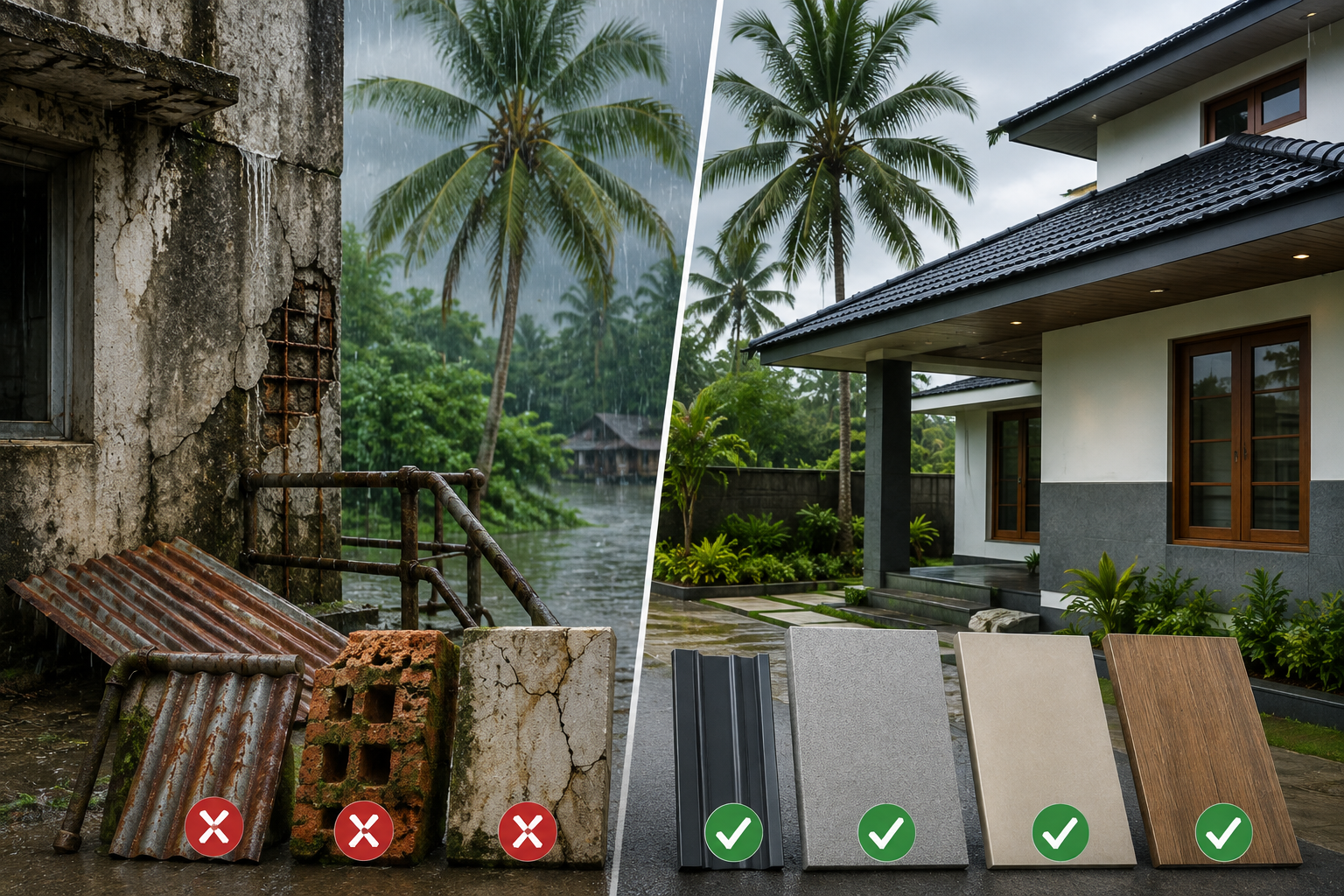
In Kerala’s climate, the materials that fail fastest are those that absorb moisture (MDF, ordinary plywood, gypsum in wet zones), those that corrode (mild steel, low-grade fasteners and hardware), and those that degrade under UV and sustained wetting (low-grade coatings, cheap sealants, polyester-coated panels). The replacements aren’t exotic — they’re usually a grade up in the same product family.
1. MDF and particle board in humid zones
Why it fails: MDF is wood fibre bound with resin. It absorbs atmospheric moisture, swells irreversibly, loses structural integrity at edges, and delaminates. In Kerala it doesn’t need direct water contact — ambient humidity is sufficient over time.
The classic pattern: a kitchen or wardrobe carcass that looks perfect at handover, with swollen bottom edges and sagging shelves within two or three monsoons. Once swollen, it doesn’t recover.
What to use instead: BWP-grade marine plywood for carcasses, particularly in kitchens, wardrobes and anything near a wet area. WPC (wood-plastic composite) or PVC board for bathroom vanities and utility areas — these don’t absorb water at all. HDHMR is a reasonable middle option for drier zones.
If MDF is used anywhere, keep it away from floor level and seal every cut edge — the edges are where absorption starts.
2. Ordinary commercial plywood
Why it fails: Not all plywood is equal. MR-grade (moisture resistant) plywood is bound with urea-formaldehyde resin, which softens with sustained moisture. It’s specified constantly because it’s cheaper, and it delaminates in Kerala conditions.
What to use instead: BWP or BWR grade with phenolic resin. Check for the IS 710 marking on marine ply, and buy from suppliers who can produce documentation — the market has a well-known problem with mislabelled sheets. Weigh the board if you can; genuine marine ply is noticeably denser.
3. Mild steel hardware and fasteners
Why it fails: Hinges, drawer channels, handles, tower bolts, window hardware, curtain rods, cladding screws. Mild steel or electroplated steel rusts in humid air without ever getting wet, and in coastal areas it happens fast.
The failure is both cosmetic — rust stains bleeding down cabinet faces and wall cladding — and functional, as hinges seize and channels stop running.
What to use instead: Stainless steel (304 for interiors, 316 for coastal exteriors), or good-quality brass and aluminium for appropriate applications. For exterior cladding fixings, stainless is not optional near the coast.
This is one of the cheapest upgrades available and one of the most visible when it’s skipped.
4. Gypsum board in wet or semi-exposed areas
Why it fails: Standard gypsum board absorbs moisture readily, sags, crumbles at edges, and grows mould. In Kerala, “wet area” should be understood broadly — bathrooms obviously, but also kitchen ceilings, utility areas, and any ceiling below a terrace with even marginal waterproofing.
What to use instead: Moisture-resistant (green board) gypsum in semi-wet zones, and fibre cement board or calcium silicate board in genuinely wet or externally exposed locations. For bathroom ceilings, consider PVC or aluminium panels which are indifferent to moisture entirely.
Also: fix the water source. Moisture-resistant board in a location that’s actually getting wet is delaying a problem, not solving it.
5. Low-grade paint and coatings
Why it fails: Kerala combines intense UV with sustained wetting and high humidity. Economy emulsions chalk, fade and grow algae. Interior paints in humid rooms develop mould behind furniture where air doesn’t circulate.
The green-black staining on north-facing external walls across Kerala is algae, and it’s a coating problem as much as a cleaning problem.
What to use instead: Exterior grade acrylic emulsions with anti-algal and anti-fungal properties, applied over an appropriate primer on properly prepared surfaces. For interiors in humid areas, washable emulsions with mould resistance.
Surface preparation matters more than the product. Good paint over a damp or poorly prepared wall fails anyway.
6. Polyester-coated ACP and metal panels
Why it fails: Polyester coatings chalk and fade under sustained UV. In Kerala the colour loss is noticeable within a few years, and it’s uneven — the exposed elevation ages faster than the sheltered one, which looks worse than uniform fading.
What to use instead: PVDF-coated panels. The coating difference is modest in cost relative to the total facade and is the single biggest determinant of how the building looks at year eight.
7. Cheap silicone and sealants
Why it fails: Sealants are doing real waterproofing work at facade joints, window perimeters and wet-area junctions. Low-grade silicone loses elasticity, cracks, and separates from the substrate under UV and thermal cycling.
What to use instead: Neutral cure silicone appropriate to the substrate, structural grade where it’s carrying load, and weather grade for exterior joints. Specify the product, not just “sealant”, and budget for periodic replacement — sealant is a consumable, not a permanent component.
8. Untreated or improperly seasoned timber
Why it fails: Kerala has termites and Kerala has humidity. Untreated timber gets both — dimensional movement causing doors and windows to jam seasonally, and termite attack that can be extensive before it’s visible.
What to use instead: Properly seasoned, pressure-treated timber from a reliable source, with anti-termite treatment of the surrounding structure. For frames in wet-prone locations, consider WPC or aluminium alternatives which sidestep the problem entirely.
Insist on moisture content verification for structural or joinery timber. Timber that arrives on site wet will move after installation regardless of what you do afterwards.
9. Plain clear glass on exposed elevations
Why it fails: It doesn’t fail structurally — it fails economically. Clear glass on a west or southwest elevation in Kerala admits substantial solar heat, and you pay for it in cooling load every month for the life of the building.
What to use instead: Heat-reflective or low-E coated glass on exposed elevations, or external shading — louvres, fins, deep overhangs — which is often more effective and more affordable than upgrading the glass.
10. Inadequate hardware on windows and doors
Why it fails: Kerala’s monsoon involves wind-driven rain, not just vertical rainfall. Windows that seal adequately in still conditions leak when rain arrives horizontally at pressure. Poor-quality gaskets harden and shrink.
What to use instead: Systems tested for water penetration at appropriate pressure, with EPDM gaskets rather than cheaper alternatives, and drainage designed into the frame so water that enters can leave.
The pattern behind all of these
Look at the list and a theme emerges: in almost every case the correct material is one grade up within the same product family, not a different product entirely.
BWP instead of MR plywood. Stainless instead of electroplated. PVDF instead of polyester. Neutral cure instead of generic silicone. Green board instead of standard gypsum.
The incremental cost at specification stage is modest. The cost of replacement after failure — including demolition, disruption and consequential damage — is many times that. And the decision is almost always made by whoever prepares the BOQ, quietly, without the client being aware there was a choice.
This is why reading the material specification in your contract matters more than negotiating the total. A quote that says “plywood” instead of “BWP grade plywood conforming to IS 710” has given itself permission to use whichever is cheapest on the day.
Three questions worth asking about any material
- What grade, and to which standard? Not “marine ply” but “BWP grade, IS 710.”
- How does it behave at sustained 80%+ relative humidity? If nobody knows, that’s your answer.
- What happens at the cut edges and junctions? Most moisture-related failure starts at an unsealed edge, not in the middle of a panel.
Frequently asked questions
What is the best plywood for Kerala’s climate? BWP (boiling water proof) grade marine plywood conforming to IS 710, which uses phenolic resin rather than the urea-formaldehyde resin in MR-grade board. Buy from suppliers who can produce documentation — mislabelling is common in the market.
Can MDF be used in Kerala? Only in dry, well-ventilated locations away from floor level, with every cut edge sealed. It should not be used for kitchen or bathroom carcasses, or anywhere near a wet area. WPC, PVC board or marine ply are the appropriate alternatives.
Why do my cabinet hinges rust even though the kitchen is dry? Ambient humidity is sufficient to corrode mild steel or electroplated hardware in Kerala — direct water contact isn’t required. Stainless steel hardware resolves it.
What causes the black-green stains on exterior walls in Kerala? Algae growth, driven by sustained moisture and shade. It’s most common on north-facing and shaded elevations. Anti-algal exterior grade coatings over properly prepared surfaces substantially reduce recurrence, though periodic cleaning is still needed.
Is gypsum ceiling suitable for Kerala? Standard gypsum is fine in dry, well-ventilated interior areas. In bathrooms, kitchens, utility areas or below terraces, use moisture-resistant board, fibre cement board, or non-absorbent panel systems instead.
Which materials should I never compromise on? Fasteners and hardware, waterproofing systems, and anything concealed behind a finish. These cost little to upgrade and are extremely expensive to replace, because reaching them means demolishing finished work.
Steelbridge Infra specifies materials for Kerala’s actual conditions across construction and interior fit-out projects. If you’d like your specification reviewed before it goes to tender, we’re happy to look at it.