Most people planning their first factory or warehouse in Ernakulam budget for the building and are surprised by everything around it. The structure is often the predictable part. Land conversion, approvals, soil conditions and utility connections are where projects slip.
This is the sequence as it actually runs, with the timelines we see in practice rather than the ones on paper.
The short version
An industrial shed in Ernakulam typically takes 8 to 14 months from land purchase to operational — of which construction itself is only 3 to 6 months. Approvals, land conversion and utility connections consume the rest. Budget ₹1,200 to ₹2,200 per sq ft all-in for a standard PEB shed with basic flooring and utilities, excluding land.
The rest of this explains where the months and the rupees go.
Step 1: Land — check these before you pay
More industrial projects in Kerala die here than anywhere else.
Land classification. Kerala’s Conservation of Paddy Land and Wetland Act is strict. If the land is classified as paddy or wetland in the data bank, converting it is difficult, slow, and sometimes impossible. Check the classification in revenue records — not what the seller tells you.
Zoning. The local body’s master plan determines whether industrial use is permitted. Land that is legally non-paddy can still be zoned residential.
Access road width. Setback requirements and permissible built-up area depend on the width of the abutting road. A narrow access road can significantly reduce what you’re allowed to build — and will also make it hard to get a trailer carrying 12-metre steel rafters to your site.
Water table and flood history. Ask neighbours what happened in 2018 and 2019. Revenue records will not tell you this. Flood-prone industrial land requires plinth elevation, which is real money.
Power availability. Confirm with KSEB whether the required load is available at that location and what the connection will involve. A high-tension connection is a project in itself.
Realistic time: 1–3 months for verification, longer if conversion is required.
Step 2: Soil investigation
Do not skip this, and do not let anyone design foundations without it.
Much of Ernakulam sits on soft marine clay and filled ground. Bearing capacities vary enormously across short distances. We have seen adjacent plots in the same industrial area where one needed simple isolated footings and the other needed piling.
A geotechnical investigation with boreholes at appropriate spacing gives you bearing capacity, water table depth, and soil profile. It typically costs a small fraction of one percent of project value and routinely saves multiples of that.
The dangerous scenario: a contractor quotes foundations based on assumed bearing capacity to keep the number attractive, you sign, and then piling becomes a variation order after work has started. At that point you have no negotiating position.
Realistic time: 2–3 weeks including report.
Step 3: Design and drawings
Structural design, architectural drawings, and services layout. For a PEB, this is where you freeze span, bay spacing, eave height, crane requirements (if any), and cladding specification.
Get the eave height right now. Raising it later is expensive and raising it after erection is not really possible. If you might install racking, a mezzanine, or an overhead crane in five years, design for it now — the marginal cost at design stage is small.
Realistic time: 3–6 weeks.
Step 4: Approvals
This runs in parallel with design and is the least predictable phase.
Depending on your project, location and industry, you may need:
- Building permit from the local body (Corporation / Municipality / Panchayat)
- Land use conversion order, if applicable
- Kerala State Pollution Control Board consent — Consent to Establish, then Consent to Operate. The category (Green / Orange / Red) depends on your industry and determines how involved this is
- Fire and Rescue Services NOC, depending on building size and occupancy
- Factories and Boilers Department approval, for units covered by the Factories Act
- KSEB power connection sanction
- Environmental clearance, for larger or specified categories
- Ground water authority clearance, if you’ll extract groundwater
Kerala’s K-SWIFT single window system has genuinely improved this for many categories, and certain industries in notified areas can operate on self-declaration for an initial period. Whether that applies to you depends on your category — check specifically rather than assuming.
Realistic time: 1–4 months, occasionally longer for Red category or where land conversion is involved. Start this early and in parallel with everything else.
Step 5: Construction
Now the fast part.
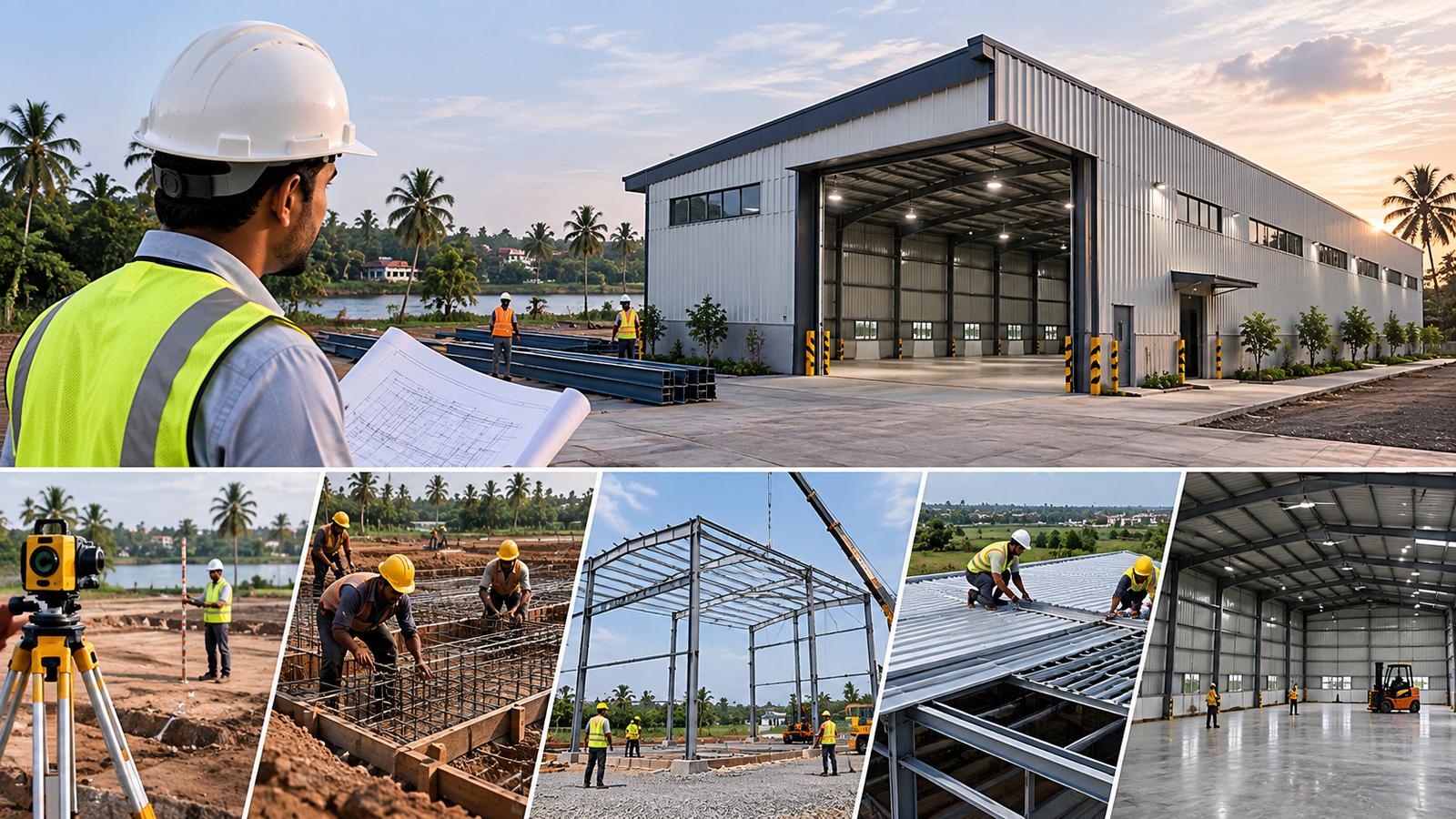
Site preparation and foundations — 4 to 8 weeks. Clearing, levelling, plinth filling, excavation, footings, pedestals, plinth beams. Longer if piling is required.
Fabrication (parallel) — 4 to 6 weeks. For a PEB, primary and secondary members are fabricated off-site while foundations are being cast. This overlap is the main reason PEB beats conventional construction on schedule.
Erection — 2 to 5 weeks. Columns and rafters lifted and bolted, purlins fixed, bracing installed.
Sheeting and cladding — 2 to 4 weeks. Roof sheeting, wall cladding, insulation, ridge and turbo ventilators, gutters and downtakes. In Kerala, get the gutter and rainwater downtake sizing right — undersized gutters overflow into the building during peak intensity rain, and it’s a common defect.
Flooring — 2 to 4 weeks. Often underestimated. An industrial floor carrying forklifts and racking loads needs proper sub-base, correct thickness, reinforcement or fibre, joint layout, and a hardener or trowelled finish. Cracked and dusting floors are one of the most frequent complaints in Kerala industrial buildings, and it’s almost always sub-base or curing.
MEP and finishing — 3 to 6 weeks, overlapping.
Total construction: 3 to 6 months for a typical 10,000–20,000 sq ft shed.
Step 6: Handover and completion
Occupancy certificate, KSPCB Consent to Operate, fire clearance where applicable, KSEB energisation, and — from your contractor — as-built drawings, warranties, test certificates, and an operations and maintenance handover.
Ask for the maintenance schedule in writing. For steel structures in coastal Kerala, the recoating interval is not optional information.
Realistic time: 3–8 weeks.
Cost heads people forget
The building quote is not the project cost. Budget separately for:
- Soil investigation
- Land filling and levelling — significant on low-lying Ernakulam plots
- Plinth elevation above flood level
- Compound wall and gate
- Internal roads and hardstanding for truck movement
- Approval fees, consultant fees, drawings
- KSEB connection and transformer — often a large number
- Water source: borewell, connection, storage, pumping
- Sewage and effluent treatment, per KSPCB category
- Rainwater harvesting — mandatory for new buildings in Kerala
- Firefighting system per NOC conditions
- Industrial flooring to actual load requirement
- Racking, cranes, mezzanine
- Site security during construction
- Contingency — 7 to 10% minimum
Projects that “went over budget” have usually gone over on this list, not on the shed.
Five ways Ernakulam projects lose time
- Starting approvals after design is finished instead of in parallel. Costs 4–8 weeks for nothing.
- Skipping soil testing, then hitting a foundation redesign mid-project.
- Scheduling foundation work through peak monsoon. Excavation in saturated Ernakulam clay in July is slow, expensive and sometimes unsafe.
- Discovering the access road can’t take a trailer after fabrication is complete.
- Design changes after fabrication has started. In PEB, members are cut to a frozen design. Changing eave height or bay spacing after fabrication means scrapping steel.
Questions to ask any contractor before awarding
- Have you built in this local body area before, and can I see it?
- Is the foundation design based on a soil report for this specific plot?
- What design wind speed and seismic zone are you using?
- Is the quote a fixed lump sum, or subject to steel rate variation?
- Who handles approvals — you, me, or a consultant?
- What is the defect liability period and what does it cover?
- Show me your payment schedule against physical milestones, not calendar dates.
That last one matters more than it sounds. Payment tied to calendar dates transfers all schedule risk to you.
Frequently asked questions
How long does it take to build an industrial shed in Ernakulam? Construction takes 3 to 6 months for a typical 10,000–20,000 sq ft PEB shed. The full timeline from land purchase to operational is usually 8 to 14 months, with approvals, land conversion and utility connections accounting for most of the difference.
What approvals are needed for a factory in Kerala? Commonly: local body building permit, KSPCB Consent to Establish and Consent to Operate, Fire NOC, Factories and Boilers Department approval where applicable, KSEB power sanction, and land use conversion if required. Requirements vary by industry category and location — verify yours specifically through K-SWIFT.
What does industrial shed construction cost per sq ft in Kerala? Roughly ₹1,200 to ₹2,200 per sq ft for a standard PEB shed including basic flooring and utilities, excluding land, approvals and specialised equipment. Heavy-duty flooring, cranes, mezzanines and high eave heights push this higher.
Is soil testing really necessary for an industrial shed? Yes. Ernakulam has highly variable ground conditions including soft marine clay and filled land. Foundation design without a site-specific soil report is guesswork, and the correction cost mid-project far exceeds the investigation cost.
Can construction continue during Kerala’s monsoon? Steel erection and sheeting continue with reduced efficiency. Excavation, foundation concreting and flooring are significantly affected. Plan foundations for the dry season where possible.
Do I need to elevate the plinth? On low-lying Ernakulam land, almost certainly. Check the site’s flood history — including 2018 — rather than relying on records alone, and set plinth level accordingly. Retrofitting flood protection is far more expensive than building the plinth right.
Steelbridge Infra delivers turnkey industrial construction across Ernakulam and Kerala — from soil investigation and approvals coordination through structure, flooring and handover, under single-point accountability.